Thursday, December 13, 2012

Star Trek: The Motion Picture


(Note: this intro ran longer than I thought it would.  The next 4 paragraphs are about the history of this film's journey to the screen, and have fuck-all to do with the movie under discussion.  Feel free to skip them.)

Star Trek originally ran for 3 fairly unsuccessful seasons on NBC from 1966 to 1969, and then was unceremoniously canceled because its ratings were shit.  Even non-Star Trek fans probably know this basic outline, because Star Trek's success as a franchise fits neatly into its underdog narrative.  The unwanted child went on to become a multi-billion dollar empire.  I mention this because I want to focus a little bit on how remarkable the existence of Star Trek: The Motion Picture actually is.  After the cancellation of the TV series, there was a (low-quality) cartoon series that ran on Saturday mornings for two seasons, from 1973-1974, and then was also cancelled with little fanfare.

This is the normal order of things.  Something comes on TV, is only popular with a tiny, dedicated audience that can't sustain it as a series, makes its way down the food chain from proper series to cartoon to syndication and, eventually, dies an unloved death as fan fiction written by cultists who can't let go.  The funny thing that happened to Star Trek is that its syndicated rerun numbers were big, really big, big enough to suggest to the people running Paramount that there was still money to be made in this universe.  Keep in mind that this happened in a world in which essentially only word of mouth could keep the memory of something alive.  There were no ancillary projects like video games or books (two original novels were created within the Star Trek universe between 1966 and 1976, neither of which was anyone's idea of a massive success.  Novels mostly came later, after the syndication numbers made Star Trek a thing again).  And there was no internet, to bring fans together to obsess over the series, and perhaps harness their energy into bringing it back.  There was only the cold, unconnected darkness of catching an episode here or there in syndication, and yet it managed to be enough.  This certainly speaks to how thoroughly the show's aesthetic connected to an entire generation of TV watchers, something I can marvel at even if I don't share in it.

They commissioned a movie first, and when they couldn't come up with a script that anyone liked, they decided to aim a little lower and create a brand-new television series, featuring most of the old characters (and their actors) along with a few new creations.  The fact that they could get just about everyone to come back for a new TV series is perhaps less remarkable, as the actors on the series were (famously) type-cast by being on the show, and bringing them back together for a new project was not as difficult as it would have been otherwise.  This show, Star Trek: Phase II, was meant to launch a brand-new, Paramount-backed network, in the same way that Star Trek: Voyager eventually did for the UPN network once Paramount finally scraped together enough money to put the plan into action (and given that UPN no longer exists, it is probably the case that they were right to scrap it the first time.)  In any event, Star Trek: Phase II disappeared into oblivion when Paramount backed out of the idea of creating a new network.

This, of course, is where Star Trek gets rescued by the villain that helped to create this monstrosity, and I'm sure the irony won't be lost on people to note that Star Wars saved Star Trek, because it proved that science-fiction on film could make a ton of money for everyone involved.  So everyone went back to the drawing board, and 10 years after it was cancelled (after an ugly, budget-gutted 3rd season that saw it shunted off to the wasteland of Friday, because no one at NBC believed in the show and they just wanted rid of it) Star Trek was reborn, not as another low-budget TV series, but as theatrical movie with a reasonably robust budget.  And this is an amazing thing to have happened, a thing that shouldn't and doesn't happen.  Sure you get the odd Serenity here or there, but that universe sank back into nothingness after the film came out.  Star Trek has been a fairly consistent part of the cultural landscape for the past 30 years, and this is sort of where the whole thing started.

So all that nonsense out of the way, let's get to this sucker, shall we?  The Enterprise is currently stationed near Earth, at the tail end of an 18-month retro-fitting.  Admiral Kirk (he is, at the moment at least, an Admiral) comes on board to lead the ship on a mission to intercept a Gigantic Blue Cloud of Doom that is barreling down on the Earth.  He replaces the current Captain, Will Decker, and demotes him to First Mate, a situation that Decker is not at all thrilled about.  Neither Spock nor Bones are currently part of the crew, but Scotty, Sulu, Uhura and Chekhov are all still hanging around.  In addition to Decker, our other new crew member is Ilia, who comes from Planet Bald, and she and Decker have some sort of (non-sexual) history, because she's taken a vow of chastity.  The Enterprise goes out to meet the Gigantic Blue Cloud and in the process Ilia is captured by it, essentially hollowed out as a person and rebuilt as a cold, unfeeling probe of the Cloud, who is now going by V'ger.  At some point both Spock and Bones join the crew, bringing the old gang completely back together.  Further exploration of V'ger reveals it to be, at its heart, one of the old Voyager probes, itself captured by a race of intelligent machines and upgraded into the Gigantic Blue Cloud. It is trying to fulfill its original mission, which is to gather data about the universe and send it back to its Creator on Earth  It regards the people of Earth as obstacles standing between it and its mission, and threatens to murder them all if it doesn't meet the Creator in person.  Decker chooses to stand in for the Creator, melds with the machine, the Earth is saved and the Enterprise flies off to its next adventure.

If I had to choose a single word to describe this movie, it would be "unambitious".  It's not that you can see the seams where a script for a single, 46-minute episode of television was expanded out into a 2+ hour movie, it's that the seams are actually enormous chasms over which have been erected a handful of rickety bridges.  Long stretches of the film basically play like a bottle episode, with everyone hanging around on the bridge and deciding how to proceed, and those parts that don't (particularly the opening section, with Kirk re-joining the Enterprise, and the climax, where our main characters get off the ship and visit face-to-face with V'ger) could very easily be jettisoned entirely, or re-written in such a way that they could happen right on the bridge too.  The whole thing is thoroughly padded out, suggesting a rush job on a script that, quite frankly, does not have enough meat on its bones to be given the feature-length treatment.  The character beats for Kirk, Spock and especially Decker are completely rushed through (Decker, in particular, could have been excised right out of the movie without doing any real harm to it), afterthoughts obviously tacked on to the film because this is a movie and movies require multiple character arcs.  Thanks to the generous padding, the film feels totally hollow and sterile, and that is not a great way to kick off a film franchise.  But we shall continue along in this endeavor, and it can only get better I guess.  As always, it's bullet point time.

It's very weird that they went with a new song, given how important to the brand the original theme is.  This would probably not happen nowadays, because fans would throw a total shit-fit about it.  The theme to this movie, of course, is much more famous now as the Star Trek: The Next Generation theme song.

There's good miniature work on the ships in this movie (primarily the Enterprise) but really, really shitty blue screen work.  Everything has a very distinctive halo effect.

We meet Spock early on down on Vulcan, I guess.  Very weird-looking place, very late-70's.  Some old Vulcan lady is threatening to don Spock with a truly ghastly necklace that represents his final break from emotion or something, but then it turns out he sucks too much and he doesn't get to wear it.

The matte painting work in this movie really dates it badly.  At Starfleet HQ in San Francisco, there's a matte painting background of the city and part of the HQ, and there are little tiny people on the painting that are frozen in place.

The Enterprise transporter is broken, conveniently forcing Kirk and Scotty to take a transport shuttle to the ship for Kirk's first return to it in some number of years(?)  This allows the camera to swirl around the model of the Enterprise while the theme plays.  It's an incredibly sexually-charged moment, two men gazing lovingly at the curves of The Only Woman They've Ever Loved for 5 solid minutes.  Of course, every time you see a long shot of the shuttle, it's obvious that it's just a shot of the two of them projected on a screen, because they look completely flat.  I'm not going to be too harsh on the effects of this movie going forward (they are what they are) but these shots really stand out badly.

Everyone stares beatifically at Kirk when he first comes on board, and Christ knows what actorly part of themselves they had to delve into in order to pretend they were happy to be stuck in a room with Shatner again.

When Kirk swipes the command from the dad from 7th Heaven (aka Will Decker), Kirk weirdly acts like a total cock about it.

More padding - someone tries to beam two people aboard the Enterprise, despite the broken transporter.  They can't materialize and get sent back to their original destination, where it is implied that they came back in some gruesome form.  It's actually a pretty cool moment all things considered, giving the movie a rare jolt of visceral emotion, but it's also totally unnecessary.

Kirk gives a presentation about the Gigantic Blue Cloud to the assembled Enterprise crew.  Among the crowd are a man and a woman in full Native American regalia, a guy with a big blue head, and some dude with a head like a butt.  Mostly just late-70's era humans though.  Disappointingly light on mustaches.

Little things - after leaving dry dock, the Enterprise makes a flyby of Jupiter.  Why?  Because.  The flyby includes a bunch of its moons all bunched together, too, as if everything was just within spitting distance.

The Enterprise enters warp and immediately goes into a "wormhole" entirely for the purpose of adding some life into a so-far completely inert movie.  And then the wormhole slows down time, which is basically the opposite of what you'd want to be doing with the movie at this point.  This whole part, which goes on for what feels like 30 minutes but is probably only 5 at most, is really unspeakably awful, with the crew getting this weird flaring effect and everyone moving and talking really slow as they try to fix the problem.

The arc that they attempt with Kirk is that he comes back to the Enterprise both unfamiliar with the crew, and not really in any sort of shape to be a Captain of a starship, and has to work through those problems.  They mostly have his dickishness bounce off of Decker, but the film's attempt to make a point about Kirk's recklessness is constantly undermined by the fact that Decker is a huge pussy about basically everything, Ackbar before Ackbar.

The Enterprise travels into the cloud and as it does so, the camera is constantly switching between long, 2001-esque light show special effects of the inside of the cloud and shots of the crew looking on in wonder.  The distrust of the audience is palpable; not trusting them to be completely amazed by the effects (and they shouldn't trust them to be, because the effects are boring), they have the crew be amazed for them.  The voyage into the cloud takes 10 solid padded minutes, with only a couple of short dialogue scenes to break up the monotony.

When the Ilia probe is returned to the ship, she wears an outfit that comes down about as far as a medium-sized T-shirt.  Why are her legs completely exposed?  Maximum value from actress and former model Persis Khambatta, that's why.

Spock goes rogue!  He goes flying into the heart of V'ger to gather information (he mind-melds with the cloud, which is pretty much just him holding his hands up to the empty air around him) and to get there he has to go through an opening that looks not a little bit but a lot like a gigantic space anus (the space anus prevents the Enterprise from proceeding any further into the interior of the cloud.)

Spock's short character journey takes him from superdick who's trying to rub out all emotions forever to enlightened half-human who sees the hopelessness of V'ger's cold machine logic and rejects it.  It basically happens in a single scene, where Spock gets religion from the mind meld and realizes he's tired of being a superdick to Bones.

V'ger finally sucks the Enterprise through the space anus, and then basically the entire leadership apparatus of the ship goes down to visit with the machine.  Why is there an atmosphere here, in the heart of a gigantic machine-based lifeform?  It's never explained.

So we get our big reveal, that V'ger turns out to be one of the Voyager probes (Voyager VI, we're told) that had had the O-Y-A blocked by space tar or whatever.  Both Voyager spacecraft were sending back pictures of the Jovian system in 1979.  There was, of course, no Voyager VI, only a I and a II, but Star Trek is always very optimistic I guess.  This reveal possibly played as interesting in 1979, when Voyager was probably in the news a lot.  Nowadays, it doesn't play as dated so much as, okay, that's something vaguely interesting I guess.  This came from Earth, not sure why they're making such a big deal about the stupid name.  (When I was a kid I had one of those big glossy books all about the Voyager missions, so this means slightly more to me than it does to pretty much everyone else in the universe, and it still doesn't really mean that much to me.  Voyager, hooray!)

They don't call black holes black holes anymore in whatever year this is.  I don't know what they call them, but not that.  Decker says that Voyager VI went through what used to be called a black hole, which is a weird thing to say if you think about it.  Why wouldn't he just use the current name of them?

V'ger wants to meld with its Creator in order to become more human.  Decker, in what amounts to a fit of adolescent impulsiveness, decides that this is all of a sudden what he desperately wants out of life.  This allows him to space-bone Ilia, which is pretty clearly why he signed up for the deal.  He and Ilia meld together in the second-most sexually-charged moment of the film, and then they are gone, becoming part of V'ger.

Tuesday, December 11, 2012

A Star Trek Movie Marathon


I do not like Star Trek.

That's not quite right.  I don't hate Star Trek, not completely and utterly.  I've watched episodes of every series that isn't Enterprise; I even liked a few of them.  But generally speaking, the world and ethos of Star Trek doesn't appeal to me.  It was born as a 60's television show, and I don't like the aesthetic of 60's era TV, and even though it's 45 years later, I think it still retains that part of it in its DNA.

So why the fuck am I doing this?  Well, first of all, so it's clear, I am going to watch all 11 Star Trek feature films, and only those things.  This is a movie blog, not a TV blog, and I am not going down the rabbit hole of watching a bunch of episodes of some TV show that I don't like that much anyway. So why?  Well, besides it being a relatively easy project to do, and something where I get the chance to perhaps snark on a sacred cow, I'm curious how these films hold up as films, as pieces of culture divorced from the TV show(s) that spawned them.  And I would like to watch the series evolve (or devolve) as the world around it changes.  This is 30 years of films (so far), and that fact reveals something about social concerns, even if the people making them didn't know it at the time.

Unlike the Bond films, I have actully watched more than half of these at some point, though I could only detail out the plot of 2, 6 and the JJ Abrams remake from memory.  So it's a chance to see a lot of these with fresh eyes, from the standpoint of someone who judges film with a critical eye and is willing to see the bad and the good anywhere it can be found.  To be clear, I am not simply watching these movies in order to take them down a peg.  I want to be surprised, and I expect to be surprised.  And I expect to be vindicated along the way too.  It's all part and parcel with the deal here.

So into the breach I will go.  We will begin with Star Trek: The Motion Picture (at some indefinite point in the very near future, I haven't quite decided yet), and I will try to recap some of the film's backstory as well as review it.

Sunday, December 9, 2012

Rango


I am, it perhaps does not need to be said, a grown-up.  And I added Rango to my Netflix queue because a lot of other grown-ups recommended that I do so, that I would enjoy the movie's liberal application of classic Western tropes (with a nice dollop of noirish elements sprinkled on top).  After watching Rango, all of this seems like the problem in a nutshell.  I could appreciate the care that the film took in applying the themes from classic Hollywood movies while all the time wondering what, exactly, was in this film for a kid.  What value could they have gotten out of the advice doled out to Rango by a Man With No Name character?  How much of Rango's "A Fistful of Dollars meets Chinatown" plot could they have possibly understood without a crash course and a road map?

Johnny Depp plays the titular chameleon, a domesticated animal who literally falls off the truck (it was a station wagon, but you get the idea) and into a tiny, dusty frontier town in the American southwest populated by anthropomorphic tortoises and moles and iguanas.  Rango uses his natural self-assuredness to become sheriff of the town in short order, and takes it upon himself to discover why the town's water supply has recently dried up.  Isla Fisher plays an iguana whose family farm is on the verge of insolvency because of the lack of water, and Ned Beatty plays the town's mayor, a desert tortoise who is portrayed in full Noah Cross mode, and whose mannerisms do not allow for much mystery as to who is the ultimate villain in this film.

It certainly looks great, with director Gore Verbinski (Pirates of the Carribean) making the sort of use of perspective that you don't always see in animated films, and the landscape having a beautifully washed-out texture.  And there are plenty of laughs to be had, a lot of them coming courtesy of a mariachi band of owls who serve as the Greek chorus of the film, showing up at regular intervals to comment on the state of the plot.  But it seems that, when you're making a movie aimed at both kids and their parents, you have to be very careful about how many of your jokes and references appeal entirely to the parents who have to take the children to the film, and Rango just doesn't do a great job of managing this balance.  It's a fun movie for what it is, but somewhat of a hollow one, relying too much on the goodwill that its (adult) audience has for Western tropes, and not enough on building its characters and its world for a broader audience.  B-

Saturday, December 8, 2012

James Bond - A Reckoning


I want to wrap up my thoughts on the series before moving on to my next project, so I want to do a few rankings lists and then do some superlatives encompassing the sublime and the ridiculous of the series, the racist, the sexist and the ever so occasionally enlightened.

Film Rankings


On Her Majesty’s Secret Service
Goldfinger
Skyfall
Casino Royale
The Spy Who Loved Me
GoldenEye
From Russia With Love
You Only Live Twice
For Your Eyes Only
Dr. No
The World Is Not Enough
The Living Daylights
A View to a Kill
Live and Let Die
Thunderball
Licence to Kill
Tomorrow Never Dies
Diamonds are Forever
Die Another Day
The Man With The Golden Gun
Quantum of Solace
Octopussy
Moonraker

Song Rankings

Diamonds Are Forever
On Her Majesty’s Secret Service
Goldfinger
A View to a Kill
Nobody Does It Better (The Spy Who Loved Me)
GoldenEye
Live and Let Die
Skyfall
The World Is Not Enough
The Living Daylights
Thunderball
For Your Eyes Only
From Russia With Love
You Only Live Twice
You Know My Name (Casino Royale)
Tomorrow Never Dies
Moonraker
Licence to Kill
Another Way to Die (Quantum of Solace)
Die Another Day
The Man With The Golden Gun
All Time High (Octopussy)

Villains

Blofeld, You Only Live Twice, On Her Majesty's Secret Service and Diamonds Are Forever
Auric Goldfinger, Goldfinger
Le Chiffre, Casino Royale
Franz Sanchez, Licence to Kill
Rosa Klebb, From Russia With Love
Raoul Silva, Skyfall
Doctor Kananga, Live And Let Die
Elektra King, The World Is Not Enough
Aristotle Kristatos, For Your Eyes Only
Brad Whitaker, The Living Daylights
Alec Trevelyan, GoldenEye
Dominic Greene, Quantum of Solace
Scaramanga, The Man With The Golden Gun
Dr. No, Dr. No
Hugo Drax, Moonraker
Max Zorin, A View To A Kill
Emilio Largo, Thunderball
Karl Stromberg, The Spy Who Loved Me
Elliot Carver, Tomorrow Never Dies
Kamal Khan, Octopussy
Gustav Graves, Die Another Day

Bond Girls

Wai Lin, Tomorrow Never Dies
Melina Havelock, For Your Eyes Only
Teresa di Vincenzo, On Her Majesty's Secret Service
Pussy Galore, Goldfinger
Vesper Lynd, Casino Royale
Aki, You Only Live Twice
Tatiana Romanova, From Russia With Love
Eve, Skyfall (yes, I know what I said in the review, but Eve fits better in this list)
Pam Bouvier, Licence To Kill
Camille Montes, Quantum of Solace
Holly Goodhead, Moonraker
Solitaire, Live And Let Die
Kara Milovy, The Living Daylights
Anya Amasova, The Spy Who Loved Me
Jinx Johnson, Die Another Day
Octopussy, Octopussy
Domino Derval, Thunderball
Natalya Simonova, GoldenEye
Honey Ryder, Dr. No
Stacy Sutton, A View To A Kill
Tiffany Case, Diamonds Are Forever


Christmas Jones, The World Is Not Enough


Mary Goodnight, The Man With The Golden Gun


Film that was the most pleasant surprise - For Your Eyes Only
Film that was the most bitter disappointment, awful Bond girl division - The Man With The Golden Gun
Film that was the most bitter disappointment, general division - Diamonds Are Forever
Most forgettable film - The Living Daylights
Favorite Blofeld - Donald Pleasance, You Only Live Twice
Worst Blofeld stand-in - Karl Stromberg, The Spy Who Loved Me
Best opening stunt - Bond skis off a cliff with a Union Jack parachute, The Spy Who Loved Me
Most embarrassing opening scene - Bond drops Blofeld down a chimney, For Your Eyes Only
Most destructive stunt - Bond destroys most of St. Petersburg with a tank, GoldenEye
Best song marred by a terrible singer - "You Only Live Twice", Nancy Sinatra
Worst song elevated by a great singer - "GoldenEye", Tina Turner
Worst attempt to make a white person look Asian - Bond in yellowface, You Only Live Twice
Worst attempt to turn an Asian character into a white person - Colonel Moon/Gustav Graves, Die Another Day
Coolest casino scene, baccarat division - Bond's very first appearance, at Le Cercle at Les Ambassadeurs, Dr. No
Coolest casino scene, non-baccarat division - Bond and Eve in Macau, Skyfall
Saddest casino scene - Bond playing blackjack by himself, Licence To Kill
Best first half - Casino Royale
Best second half - On Her Majesty's Secret Service
Most deflating first half - Dr. No
Most deflating second half - Moonraker
Favorite Bond girl in an otherwise awful film - Wai Lin, Tomorrow Never Dies
Worst Bond girl in an otherwise stellar film - Natalya Simonova, GoldenEye
Best use of underwater filming - The submarine car, The Spy Who Loved Me
Worst use of underwater filming - Basically the entirety of Thunderball
Best stunt filming - The opening scene, Skyfall
Worst stunt filming, non-CGI division - All of Quantum of Solace
Worst stunt filming, CGI division - The kiteboard escape, Die Another Day
Best use of an alpine setting - Blofeld's mountain hideaway, On Her Majesty's Secret Service
Worst use of an alpine setting - Bond snowboards to a brutal cover of "California Girls", A View To A Kill 
Most racist against Asians - Goldfinger
Most racist against black people - Live And Let Die
Most racist against white people - Quantum of Solace
Favorite Q moment - Q threatens Bond with murder if he doesn't bring the car back in one piece, Tomorrow Never Dies
Most upsetting Q moment - Q has to deliver the re-entry quip, Moonraker
Bond dresses like a clown memorial mention - Octopussy
Coolest use of a circus - Just kidding, no such thing.
Dirtiest Bond girl name - Plenty O'Toole, Diamonds Are Forever
Most inexplicable Bond girl name - Tie, Christmas Jones, The World Is Not Enough and Strawberry Fields, Quantum Of Solace
Most surprisingly competent Bond girl despite a ludicrous name - Pussy Galore, Goldfinger
Coolest climax - Bond and M protect this house!, Skyfall
Worst climax - Space lasers, Moonraker
Weirdest climax - Bond chases Scaramanga through his funhouse, The Man With The Golden Gun
Plot twist that actually upends the meaning of the film - Elektra King is actually the Big Bad, The World Is Not Enough
Plot twist that adds absolutely nothing to our understanding of the film - Colonel Moon becomes a white person, Die Another Day
Coolest boss base - The volcano, of course, You Only Live Twice
Crappiest boss base - Max Zorin's blimp, A View To A Kill
Best henchman - Jaws, The Spy Who Loved Me
Worst henchman - Jaws, Moonraker

Friday, December 7, 2012

Skyfall


Note: I am going to spoil the everloving shit out of this movie, and it is one of a very small handful of Bond films that can actually be spoiled.  If you do not want to have this happen, then come back once you've seen it.

Since about 1990, the most common state of the Bond film series has been "troubled", thanks to MGM's recurrent financial difficulties.  They held up the production of GoldenEye (and hastened the end of the Dalton era), played a role in the decision to reboot the series with Casino Royale (and the exit of another actor) and delayed the production of Skyfall while MGM went through bankruptcy proceedings.  Quantum of Solace was rushed into production in order to cash in on the success of Casino Royale, but Bond laid fallow for 4 years after that, the longest break in the series that didn't involve a role recasting.

Sam Mendes was hired to direct Skyfall very early in the development process, and the rumor mill constantly swirled around whether he was going to leave the project or not as MGM struggled to get its financial house in order.  In the end, of course, Mendes stuck around, and the end result was a film that not only reversed the massive decline of Quantum of Solace, but legitimately lands the film in the top 5 of the entire series.  I'm going to nitpick this movie, because that is what I've signed up for, but it is a fantastic piece of action cinema, marrying interesting character beats with well-shot, competently edited action scenes.  Skyfall's success paves the way for the Bond film series to live indefinitely into the future, and since I don't think there's any real clamor for the Bond series to pick an end date in order to wrap up its mysteries (who, exactly, is the mysterious person who tailors such incredible suits?), that's probably something that no one will really complain about.  I look forward to coming back in a few years to cover "The Hildebrand Rarity"*

* May not be the actual title.

Let's do the plot first, shall we?  Bond and inexperienced but enthusiastic MI6 agent Eve are on a mission to recover a stolen list of undercover intelligence operatives from some asshole.  During the course of the mission, Eve ends up shooting Bond, who falls off a bridge and into presumed dead status, and the asshole escapes with the list.

MI6 headquarters gets infiltrated and blowed up real good, forcing the department into a more (supposedly) secure underground headquarters and Bond out of his self-imposed exile (surprise - not dead).  Bond is forced to recondition himself, and despite the misgivings of a (seemingly) craven bureaucrat played by Ralph Fiennes, M sends Bond back into the field and after the asshole (whose name is Patrice, so I'll stop calling him that, but really.)

Bond follows the leads up the food chain until he eventually gets to Raoul Silva, a former MI6 agent played by Javier Bardem.  Silva is bent on revenge against M for abandoning him to torture at the hands of the Chinese, and he puts a plan into place to kill M at a public hearing into her part in allowing the list to get stolen, and although he is unsuccessful he manages to escape, so Bond takes M to his ancestral home in Scotland, to hole up and make a stand against Silva on friendly ground.  Silva arrives, is thwarted by Bond, but manages to, in the movie's big surprise, kill M before being killed by Bond.  Upon Bond's return to London, Fiennes' character (who had proven himself to be more than just a bureaucrat, and has earned the trust of our heroes) has been installed as the new M, and Eve has been revealed to be Moneypenny.  M asks Bond if he's ready to continue his work on Her Majesty's Secret Service, and he says he is, roll credits.

So I have to get this out of the way first, and that is the smallness of Silva's plot.  He goes to all the trouble of acquiring this NOC list (Mission: Impossible up in this piece!) just so he can terrorize and humiliate M (he murders some of the people on the list, and makes sure he publicizes that fact), with the ultimate goal being to get up close and personal with her so he can kill her.  The stakes of the movie, which start very high with an enormous list of undercover operatives being stolen, eventually telescope into something very small, with Bond's job simply to protect M's life.  This is a defensible choice from the standpoint that it allows for some real character revelations for Bond and especially M, but for those who complain that it makes Bond's mission seem kind of petty and small well, I sympathize with that criticism.

While I was personally somewhat underwhelmed by the big parkour set piece in Casino Royale, I find absolutely nothing to complain about in this film's opening action sequence.  This is simultaneously one of the coolest and one of the most batshit things Bond has ever done:


I'd also ask you to notice the composition of that scene.  Notice how well the geography is established, and how the scene has a kinetic action pace without relying on shaky-cam gimmickry.  The question going into this film was whether Mendes could handle Bond-style action.  Well, there's your answer.

While I'm at it, of course, I have to mention Roger Deakins, who is Sam Mendes' go-to cinematographer (and who is more famous as the Coen Brothers' regular lensman.)  It is impossible not to notice how great this film looks from beginning to end, and people have rightfully pointed out two scenes in particular, Bond's fight with Patrice on the top floor of a Shanghai highrise with neon images shimmering and swirling in the background, and the nighttime battle at Skyfall (the Bond estate) with Silva and his henchmen.  The former scene, in particular, represents a really creative way to indulge in some theatrical Bond film set design without having to break suspension of disbelief with a volcano base or its equivalent (I'll come back to the latter scene in a bit).

Some people probably love the theme song; I like it, that is all.  It's the best theme of the Craig era by a mile, and Adele proves why she was the perfect choice to sing it, but there's something a little sterile about the song.  An above average Bond theme, no doubt, but not an upper echelon one.


There is a legitimate debate about who the primary Bond girl in this film actually is, and I am in the camp of those who say that it's actually M (the other possibilities are Naomie Harris's Moneypenny, and Berenice Marlohe's Severine).

Severine is the person who actually leads Bond to Silva, and Marlohe is unquestionably in the mix for hottest Bond girl ever.  For an underwritten role, Marlohe does some good work giving the character a bit of depth, and it is probably the film's worst moment when she is unceremoniously killed by Silva.  This is the third straight film where the secondary Bond girl gets killed in really shitty circumstances for the explicit purposes of showing the audience just how bad the bad guy actually is, and it's a trope that needs to be put out to pasture.

For someone who often has chemistry problems with female costars, Craig really got linked up with a couple of solid ones with Eva Green's Vesper Lynd and now Naomie Harris.  The onscreen connection between Bond and Moneypenny has never been as smolderingly sexy as it is here, and the idea of Harris's Moneypenny continuing to show up to flirt with Bond and take him down a peg or two when needed makes me very happy.

What to do with Javier Bardem?  I'm still not sure if his performance is just the right amount of crazy, or too over the top.  The scene where he throws a bit of gay-panic shade at Bond when they first meet is pretty stupid, I will grant that, but Bardem really gives Silva a degree of menace that is often missing from this series.  Even though we only see him commit the one cold-blooded murder, he gives off a distinctively Lecter-ian vibe.  And I think his classic Bond villain deformity is perfectly creepy.

Q!  The return of Q!  As some cocky little computer savant!  Oh, this is very nice.  Ben Whishaw's dumb, floppy hair is absolutely the perfect cherry on our new Q sundae.  I wish he had cooler gadgets for Bond than a little GPS tracker and a gun that gets one use out of its unique property and then is immediately lost, but new Q is a pitch-perfect update of the character.  Yes, thank you John Cleese, your services will no longer be necessary.

Does Bond have to go to a bitchin' Macau casino?  Damn right.  Does he have to wear a perfectly-tailored tux to go there?  You bet your ass.  Does he play baccarat while he's there?  Well, two out of three ain't bad.

The film, being released in the 50th anniversary year of the Bond flicks, is chock-full of references to old Bond movies like Die Another Day was, but since I've only seen it in the theater I didn't really have a chance to make note of them.  The only one that everyone remembers, and it's a doozy of a cool scene, is when Bond opens the garage door in which sits the car that he plans to take M to Scotland in, and it reveals the Aston Martin from Goldfinger, complete with passenger-side ejection seat.

I guess I have to cover the second big, "I don't really get why they did this" part of the film, and that is the reveal of Bond as the scion of a castle-owning Scottish family that he apparently was estranged from before his parents' death.  Like I mentioned in the Casino Royale review, this undermines the background that Vesper imagines for Bond (and hers seemed much more plausible than this, that he was an orphan with anger management and self-control issues who MI6 targeted young).  I believe that Skyfall's posited background for Bond squares with Ian Fleming's, so I can't complain too much, but I certainly preferred the other background better.  Bond as an up-from-his-bootstraps orphan who takes to the finer things in life as almost a defense mechanism is more interesting than Bond as an aristocrat who was born into a knowledge of clothes and wine and good food but was too much of a self-involved brat to stick around and help manage the estate.

Yes, the final scene has some pretty clear Home Alone overtones, and everyone can enjoy making those jokes.  More importantly, though, it represents a really interesting inversion of the usual "assault the base" climax of a typical Bond film.  The base here is being guarded by, not the bad guys, but the heroes, and the villain is the one who brings a strike force to help get him in.  Like most people I am somewhat confused as to why Albert Finney is in this movie (he plays the gamekeeper of Skyfall, and helps Bond and M protect the estate against Silva and his men) but, hell, he's an actor with all sorts of gravitas, and he gives Craig a chance to do some pre-assault banter, so why not.  Like I mentioned earlier, it is one of the most beautifully composited scenes ever done in a Bond film, with the Bond manor being put to the torch against a pitch-black night sky.  And the action here, if you can get past the Home Aloneness of it all, is really well done, with the various makeshift booby traps that our three heroes set off to kill the bad guys helping to give the scene a real underdog flavor.  Our good guys are fighting for their lives, and every time they catch another henchman in a trap it's impossible not to feel a thrill.

I have mostly not commented on the women's fashions in these movies, because I am even less qualified to talk about them than I am the men's fashions.  I'll make an exception for Moneypenny's dress that she unveils at the end, which is a very nice little Easter Egg, a clear shoutout to the dresses that Lois Maxwell used to wear.  I'm a little disappointed that Moneypenny immediately gets stuck behind a secretary's desk after a single film in the field (I thought it would have been a nice right turn for the film to suggest moving her behind the desk before rejecting that idea and keeping her out in the field) but I look forward to how they manage to work her character into the film series.  This Miss Moneypenny is capable of so much more than sitting in M's office and flirting with Bond, and even if she only gets to do the sort of backup work that she does in the Macau casino scene (where she's another set of eyes for Bond, and she flits in and out of the scene while maintaining a constant stream of dialogue with Bond; it's a really cool scene, and I'm not doing it justice), well, at least that would be something.

Back in his English Patient, heartthrob days, you wouldn't have thought that Ralph Fiennes would one day be perfectly cast as a grey English bureaucrat, but you'd have been dead wrong.  It's the hair that does it.  After he asks Bond if he's ready to continue his work, we get a gunbarrel scene, the Bond theme kicks in, and the film cuts to the credits.  And I realize that I'm a total hypocrite for how much I loved this despite the fact that I hated it with a burning passion in Quantum of Solace, but I will rationalize it by pointing out that Skyfall represents a genuine evolution in the Craig era, with a new M and Moneypenny and Q now all on board, whereas Quantum of Solace represented just a boring status quo ante, with everything winding up the same way they did at the end of Casino Royale, with all the same beats repeated.

Bond sleeps with Severine, and although I like the character a billion times more than I liked Strawberry Fields, she is also here in part because none of the other women in the film were sexually available to Bond, and he has to sleep with someone.

Thursday, December 6, 2012

Quantum of Solace


Here are the men who directed all of the Bond films through the Dalton era:

Dr. No - Terence Young
From Russia With Love - Terence Young
Goldfinger - Guy Hamilton
Thunderball - Terence Young
You Only Live Twice - Lewis Gilbert
On Her Majesty's Secret Service - Peter Hunt (the oddball film, in basically every sense)
Diamonds Are Forever - Guy Hamilton
Live and Let Die - Guy Hamilton
The Man With The Golden Gun - Guy Hamilton
The Spy Who Loved Me - Lewis Gilbert
Moonraker - Lewis Gilbert
For Your Eyes Only - John Glen
Octopussy - John Glen
A View to a Kill - John Glen
The Living Daylights - John Glen
Licence to Kill - John Glen

Hunt only did the one film as director, but he edited the first five.  Other than him, you have basically 4 "house" directors of the franchise (Young, Hamilton, Gilbert and Glen), people who stuck around for multiple films and were part of a larger James Bond team, with producers and editors and whoever else creating fully collaborative films.

Since the beginning of the Brosnan era, the directors of the films have been more of the "gun for hire" sort, men (and, again, always men) who come on for a film, give it as much of their personal style as the franchise allows, and then move on to other things.  I have mostly not talked about the directors in these recaps (with the odd shoutout here or there to Martin Campbell) because for the most part they are kind of incidental actors, people who bring a certain tone to the film but mostly just set up the action and the story and let it happen.  But Quantum of Solace cannot be talked about without coming to terms with Marc Forster's job as director.  I don't know any other way to say it - the film is incompetently directed.  Forster is not, all things considered, a hack of a director.  I liked Finding Neverland enough, even though I'd never watch it again, and Stranger Than Fiction was an oddball little lark.  But he botched Quantum of Solace so completely that he simply can't escape notice here.  He should not have been hired to make this picture.  There is certainly a good Bond flick to be made with the raw materials he had to work with here, and there's still a salvageably okay Bond flick peeking out at the margins of this film.  But, given just what's on screen, this is a terrible Bond movie.  It is saved the ignominy of being the worst film in the series only because the depths of the Moore era still exist, and can't be wiped away.  It is the worst non-Moore movie in the series, and that is an amazing feat considering how effectively Casino Royale pulled the franchise out of its late-Brosnan era tailspin.  I mean, I legitimately found basically nothing to like about this movie, and even with a turkey like Moonraker I thought there were decent elements in the first half of the film.

But, since I have set myself the task of going through these films with a fine-toothed comb, and since I am so close to the finish line, I will go once more into the breach, and bullet point this horrid piece of shit.

The opening scene sets the table with utter perfection, in that it is an incoherent mess of shaky-cammed, poorly-edited action that goes from nowhere to nowhere.  Bond is in a car, he has the mysterious Mr. White from the end of Casino Royale in the trunk, and he is being chased by some villains that he I guess dispatches of.

Cut to the Jack White-penned song, which also features Alicia Keys.  Picking gems out of turds - I like the opening guitar riff of the song.  I like not a damn other thing about it.  Supposedly Amy Winehouse was the first choice of the filmmakers, but she was (unsurprisingly) not in the sort of shape that would be required, and couldn't do it.


The plot, so far as it goes - in our only direct sequel in the entire franchise, Bond goes tracking after the shadowy organization, named Quantum, that was responsible for bankrolling Le Chiffre and also Vesper Lynd's death.  The trail leads him to one Dominic Greene, a slimy little creep played by Mathieu Amalric, who apparently represents some high level of the organization.  Greene is engaged in a scheme to replace the Bolivian government with some petty Generalissimo - in exchange, he forces the General to hand over water rights in the entire country to Quantum.  Along the way, Bond links up with Camille Montes, a woman whose family was killed by the General when she was a little girl and who is bent on revenge against him.

Two massive problems here.  Number one, Quantum is clearly meant to evoke SPECTRE.  That organization was the villain in 6 of the first 7 Bond films (Goldfinger's the odd man out) before vanishing from the series due to copyright issues.  We met SPECTRE slowly, getting a little piece of the organization here and a little piece there, but starting with From Russia With Love, we always knew we were on the trail of a man named Blofeld, who headed this organization, and we knew generally what they were after (massive extortion schemes through terrorism.)  Quantum, on the other hand, is just a big cloudy ball of nothing.  Who is Greene?  Who does he work for?  What, ultimately, is his aim?  The organization doesn't come into any sort of focus at any point.

Number two is the scheme around which this movie is based.  I don't mean to sound petty and provincial but, honestly, who gives a shit about water rights in Bolivia?  This is what Quantum wants to spend its time dicking around with?  Let 'em.  This is a big planet, with a lot of dangerous people in it, and Bolivia is a small country and, seriously, I'm falling asleep just thinking about the smallness of this horseshit.

So anyway, during the interrogation with Mr. White Quantum reveals its existence and that it has people everywhere, and M almost gets shot.  There's a chase scene with Bond and some Quantum operative and it features some cool ideas, including a mid-air brawl suspended on ropes, but it is so completely botched by the awful shaky-cam, quick edit, Bourne-aping direction.  Did I mention Bourne-apery?  That is the strongest theme of this dumb movie.  The final shot of the scene is actually alright (it got featured in all the trailers) with a dead-eye shot from Bond directly into the camera to finish off the bad guy.

Judi Dench is still doing good work here, God bless her.  It's funny to think back to the Brosnan era and remember how little use the films made of her, and even though she's playing the same character here it's almost as if she isn't, because M is an actual character in the Craig era, and not just an exposition machine.

Another thing that pisses me off about this movie - it is, on some level, a Tomorrow Never Dies redux, with Bond tracking a weedy little doofus that he immediately suspects of being a bad actor for really no particularly good reason.  I mean, he certainly has an idea that Greene has some place in the Quantum organization, but he hates him on a visceral level well before we see him do anything much but be mean to his girlfriend.

That girlfriend is the aforementioned Camille Montes, played by Olga Kurylenko as a variation on the Melina Havelock archetype, only more exotically multi-cultural.  The problem is that Havelock's revenge quest was triggered by something that happened on screen, whereas Montes' is described solely through exposition, so it does not have anywhere close to the same impact.  We know she hates this guy, and we know why, but it never really coalesces.

Quantum holds a meeting by having a bunch of their operatives attend the same opera and speak into ear pieces.  It's a reasonably cool update of the old-school, theatrical (literally, in this case) villain meeting, usually taking place around a table in some impossible underground (or underwater) structure.  It is, of course, marred by another awful action set piece that doesn't make any sense.  Besides the shaky cam and the quick-cut editing that doesn't allow for any sense of geography, Forster keeps cutting to the opera on stage, and to this giant eye that forms the focal point of the set, for reasons that only he could possibly explain.

We meet Strawberry Fields, our secondary girl, at the La Paz airport.  Bond has gone off the reservation in pursuit of Greene and Quantum, and she shows up to bring him back home. She originally takes Bond to some fleabag place in town to hole up for the night before catching a flight back the next day, but he bullies his way into an upgrade at some classic Bond swankorama hotel and really, that's just fine.

Strawberry Fields is the worst kind of Bond girl throwback, someone who allows Bond to completely overwhelm her own good sense at all times (besides just having an incredibly stupid, but not terribly ribald, name) and then dying in service of the plot.  She immediately falls into bed with him and it is supposed to be...charming, I guess?  It is not.  Then eventually she is killed offscreen, in a death that is meant to evoke Goldfinger, with Fields all covered in a substance lying facedown on the bed, but instead of gold it's oil.  See, oil is the new gold!  Get it?  Get it?  Fuck.  Fields' only job is to keep an eye on Bond and keep him from escaping for 24 hours, so naturally she lets him go as soon as the opportunity presents itself, because she is a painfully ineffective cipher of a character.

Dominic Greene's cover story is that he's an environmentalist, because it's important to show what a hypocrite he is.  I hate so many things about this movie that the reactionary politics don't even register that much with me but come on.

Since this will be our last Felix Leiter sighting of the marathon, I do want to throw in my little pet theory, which is that Leiter has adventures just like Bond does, where he gets to travel to exotic locations and thwart the maniacal plans of supervillains and screw beautiful women in service of American interests, and Bond shows up occasionally during those adventures to offer a bit of moral support and perhaps some equipment or small piece of intelligence to get his investigation into gear.  Leiter is completely wasted in this movie, spending most of his time pouting that his partner, Moustache McDouchebag, is totally onboard with CIA orders that Greene be cultivated as an ally, rather than investigated as a villain.  And you know what?  Moustache is right.  If the CIA wants to be in bed with scumbags like Greene in order to protect the interests of the US, then that's what they should do.  Leiter isn't some private dick.  He works for Uncle Sam.  This is his job.

At some point, Bond goes flying into the desert after Greene with Montes.  They engage in an (ugly, as if there's any other kind) action set piece involving dogfighting aircraft, and the two of them end up basically free-falling into a gorge after the plane gets shot down.  At the last minute Bond pulls Montes' chute and both of them land hard but alive on the floor of the gorge.  Bond films ask you to suspend your disbelief a lot, and you go with it because they're Bond films, not documentaries.  Yes, Bond can ski off a cliff and pull a Union Jack parachute as he's falling.  Of course he can.  But the way this scene is shot and edited, Bond pretty clearly does not get to the parachute in time to prevent massive injuries to both parties on landing.  It's a small thing, really, but it's another indication of just how little Forster cares about the movie he is making.

Another rare compliment!  The scene where they walk out of the gorge is nice, with Spanish-inflected music on the soundtrack.

So back in La Paz, M is pissed at Bond and orders him suspended and sent back to England under guard.  Bond escapes, as he always does, knocking out a bunch of MI6 operatives and eventually running into M during his getaway.  Immediately, M is back on Bond's side, insisting to anyone who matters that it is important that Bond be given room to investigate Greene.  There is absolutely no justification given for her about face, except that before Bond was in her custody, and now he's managed to escape.

So, whatever, Bond tracks Greene out to some doofy desert hotel, where he and the General are finalizing their arrangement (Oona Chaplin, Talisa from Game of Thrones, has a small role as a serving girl that the General tries to, ugh, rape), and Montes gets her revenge while Bond gets his, the place gets blown up for nebulous reasons, and then something something Vesper Lynd's ex-boyfriend works for Quantum as a fuck machine who gets the female agents of the world's various intelligence bureaus to give up information to him, which Bond puts a stop to.  The Canadian agent that he's working on at the end of the film is played by Stana Katic from Castle, and she has (I believe) one line.

There's a gunbarrel scene tacked on at the very end (there was none at the beginning, which honestly who cares, it is what it is, the Craig Bond doesn't do them anymore, so be it) as if to say, here you go you jackals, this is what you wanted.  The Bond theme plays and then the credits roll, in a direct ripoff of the end of Casino Royale.  Fuck you, Marc Forster.  You are the worst.

Bond sleeps with Strawberry Fields, and it is painfully obvious that she is only in this movie because Bond had to sleep with someone, and Montes was both emotionally and physically unavailable to him.

Monday, December 3, 2012

Casino Royale


In 1999, MGM studios, which has owned the Bond film rights since they bought United Artists back in 1981, acquired the rights to film the novel Casino Royale from Sony (according to wikipedia, the acquisition involved the rights to make a Spider-Man film going back in the other direction, from MGM to Sony, which involved Sony receiving the James Cameron script treatment that eventually turned into the Sam Raimi movie in 2002).  Casino Royale was the big hole in the Bond film canon, the one full-length novel (and Bond's debut to boot) that Eon films had never been able to make a film of.  Things worked out very nicely for MGM in these regards - when Pierce Brosnan walked away (or was forced out, who knows with Bond) after his 4 film deal expired, MGM had the opportunity to recast the part, and reboot the franchise, with the first Bond novel ever written.

Daniel Craig was an inspired choice to play Bond.  He was not a big star at the time - the odds, if there were a such thing, were on Clive Owen, who had a much bigger profile and had already done a bit of a Bond dry-run in Croupier.  Craig has a physical immediacy that none of the other actors who has played the role possesses; you never have any difficulty believing that he could lapse into brutal violence at any moment.  Connery could be brutal, to be sure, but he wasn't physical in the way that Craig is (and his last couple of films, featuring extremely lazy performances, sucked a lot of the edge from the character.)

So it's within this context, with the perfect Bond actor situated in the perfect Bond story, that I have to confess that I was ever so slightly disappointed with Casino Royale on what was my third viewing of the film.    It'll land pretty comfortably in my top five all time, to be sure, but I had placed it as A#1 with a bullet in my mind, and it didn't quite get to that level.  I identified three problems with the film that stuck with me, one minor, one medium and one major, and I'll point them out as I get to them.  I'm not going to recap the plot of the film, because it's pretty straightforward and I'm sure most people have seen it recently enough to remember the general outline.

First things first though, the opening scene might just feature the coolest moment in the entire Bond canon.  We get an intercut scene of Bond's first murder (which is our first "Daniel Craig gets down and dirty" fistfight, though far from our last) with his second, which is cool and clean, and when target number two begins "you needn't worry, the second is..." Bond aces him before he can finish the thought and then says, "Yes.  Considerably."  Fucking awesome.

I don't know whose idea it was to have Chris Cornell sing the theme song (in full-on hunger-dunger-dang rock mode, no less) but it was a very poor choice.  I actually suspect the theme song is decent (and it contains elements of the OHMSS theme, which I've waxed rhapsodic about enough at this point) but Cornell's caterwauling is just awful.

I'll start with my medium problem with the movie, which is that the action never really gripped me.  The most famous stunt is the first one, where Bond chases some living MacGuffin in a fully-realized parkour action stunt scene.  And as much as I admire the scene from a technical standpoint, I never really got much of a thrill from it, unless it were to say, "Bond, it is very high up there, wouldn't you like to get down and perhaps drink a martini."  The most underwhelming action scene, in my mind, is the chase at the airport, where one of Le Chiffre's minions attempts to blow up a brand spanking new jet plane.  It's very drab, and very dark, and cribs a bit too much from Raiders of the Lost Ark for my taste.  It has a funny button at the end though, when the bad guy gets blowed straight up by his own bomb.

Le Chiffre might be the second most famous Bond villain, after Blofeld, and it's a real tribute to Mads Mikkelsen that his performance easily outshines both Peter Lorre's and Orson Welles' in the public consciousness.  Now, granted that both of those men played the character in non-Eon, mostly forgotten films, but Mikkelsen is great in the part, giving Le Chiffre the right mixture of arrogance and petulance.

I wanted to dive into Bond continuity a little bit, so if that's the sort of thing that doesn't interest you (and really, it shouldn't, because it's a very silly thing) then skip this paragraph.  Okay, so, the most straightforward reading of Bond series continuity is that the films proceed in chronological order, with Bond being a single man, born James Bond, who works for M and MI6.  It takes a good deal of suspension of disbelief, of course, with Bond's changing face and the political situation of the world morphing over the course of 50 years, but if you're willing to do that then you start from there.  This movie throws a major monkey wrench into that idea, though, because the Bond of Casino Royale is very clearly at the start of his career (and M uses the line "I knew it was too early to promote you" so you can't really fall back on the idea that the opening scene happened way in the past, and everything else happens in the present).  But in GoldenEye, Bond referred to M's predecessor, meaning she was just starting the job at that point.  So this doesn't square.  A common fan theory, an obvious one, is that James Bond is simply a code name, and that each actor who takes the role is a new man, assigned that name and that number and proceeding through time in a normal fashion.  This would work out perfectly if it wasn't for one problem - Tracy, Bond's late wife, who is referred to by Connery, Lazenby, Moore and Dalton.  Perhaps a hybrid of the two would work, that those four are one man and Brosnan/Craig are separate men from them, but it's all very convoluted and broken at this point (and will only get more broken with Skyfall).  This is not a series for continuity hounds.

Judi Dench immediately has more interesting things to do than she had during the entire Brosnan run.

Bond checks his Sony Ericsson phone so many times that it almost reads as a meta gag about the ubiquity of product placement in the Bond films.

Bond wins his 1964 Aston Martin from some greasy Eurotrash scumbag that he's tracked to the Bahamas and I bet the car stinks like Drakkar Noir and garlic.

The interplay between Vesper Lynd and Bond in their first meeting aboard the train is among the best things that has ever happened in a Bond movie, and it's a little bit of a shame that the family background she intuits for Bond (their interplay is based on each making judgments about the others' background from first impressions) is undermined by Skyfall.  Eva Green makes a very impressive Vesper, and if she doesn't land in my top 3 Bond girls it's only because the character is given too little to do.

There's a real playfulness to Craig's performance that I'd forgotten.  Craig can be a dour, humorless presence on screen, a problem that I think is getting worse (he was the worst thing about The Girl With The Dragon Tattoo), but in this film he is actually pretty damn charming.

The movie implies that Vesper is the first person to ever put Bond in a finely-tailored tuxedo, and man does it look like great.  Latter-day Bond films do not skimp on the tailoring budget, that's for damn sure.

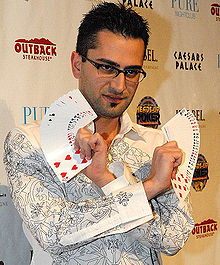
The center of the film, which is the center of the novel, is a card game between Le Chiffre and Bond (plus a bunch of other players, including the return of Felix Leiter for the first time since the Dalton era.)  Then we get to my minor problem, the game.  The trappings of the game are super swanky, featuring Montenegro's coolest hotel and a bunch of dressed up people playing the highest of high stakes cards.  But the game, as you know, is Texas Hold'em, and it is so deeply, deeply uncool.  Not as uncool as the backgammon he played in Octopussy, but uncool enough since it places the film firmly in 2006, when poker was all the rage.  It dates the movie terribly and, worse still, suggests to douchebags like this:


that their chosen "profession" is so cool even James Bond plays it.  They are wrong.  Bond, as a world-class dilettante, plays baccarat, a game of fairly minimal skill, because he doesn't have time to learn proper game-playing strategy while he's memorizing wine vintages, screwing beautiful ladies, and occasionally getting off his ass long enough to save the world.

I love Jeffrey Wright and he, as per usual, makes the most of his limited time on screen as Leiter.

The scene right after Bond kills the two African warlords (who were after Le Chiffre for some money of theirs that he lost shorting airline stock, hence the attempted plane explosion) at the hotel is like no other scene I can remember in any of these films.  The way Martin Campbell shoots the consequences of his violence is really remarkable, with quick cuts of Bond cleaning the blood off of himself interspersed with shots of a decanter and tumbler filled with whisky that Bond downs; he upped his game for this movie.  Then the shot of Vesper and Bond in the shower is done in a single long take, with the scene ending as Bond wordlessly comforts the distraught Lynd as the camera slowly zooms out.

"Shaken or stirred?"
"Do I look like I give a damn."
- A line that singlehandedly adds a half a letter grade to this movie.

The poisoning scene reminds me a lot of the (very goofy) tarantula scene from Dr. No, with a lot of closeups on Bond's sweaty face.  Here it's played totally serious.  Actually, it was played serious in Dr. No, it's just that you could clearly demarcate when Connery was in a shot and when his double was (hint: the double is in scenes where the tarantula actually touches skin).

So, my major problem.  The last 30 minutes or so of the film happen after Le Chiffre has already been offed (he goes out like a total chump, shot by someone who isn't even Bond, but that's sort of the whole point), and Bond and Vesper running off together to Venice, with Bond even turning his resignation letter in to M.  This is all well and good in a film that's just the 21st Bond picture, with Bond getting sucked back in to action courtesy of Le Chiffre's bankrollers (and Vesper's double cross) serving to put a capper on the notion that Bond has to be bury his emotions to adequately do his job.  But it is completely undermined by the fact that this is implied to be Bond's second mission as a 00 agent.  I gather that the novel was supposed to be an in media res opener on Bond's already-in-progress career, so when he runs off with Vesper (and ultimately denounces her after discovering her double cross), it is meant to tell us something profound about Bond's character.  But in a movie where we are asked to believe that Bond has just started his 00 career, for him to immediately throw it away for Vesper suggests something else, that he is impulsive and emotionally attached to basically everyone. I get that this film says, this is who Bond was before he "got religion" and decided to remain closed off to everyone as a means of protection, but it just never squares, for me at least, with the Bond that we've known through 20 films prior.  That Bond turns his charm on and off, not as a means to protect anyone, but because he's easily bored and kind of a dick.  It also kind of sucks that we learn the details about Vesper's betrayal through post-hoc exposition delivered by M - the last 30 minutes are a real rush job after the languid pace of the rest of the movie, with an enormous amount of plot and character dumped into a tiny space, the audience left to sort the whole thing out mostly on its own.

The film suggests (and then follows through with, in the next film) a direct sequel, which I was very excited about at the time it came out.  Stick around to find out how that turns out!

Bond sleeps with Vesper, probably a bunch of times.  He never manages to close the deal with the very sexy  Catalina Murino, who plays Mr. Eurotrash's girlfriend and gets an ugly and very unfortunate Bond Girl Death.